
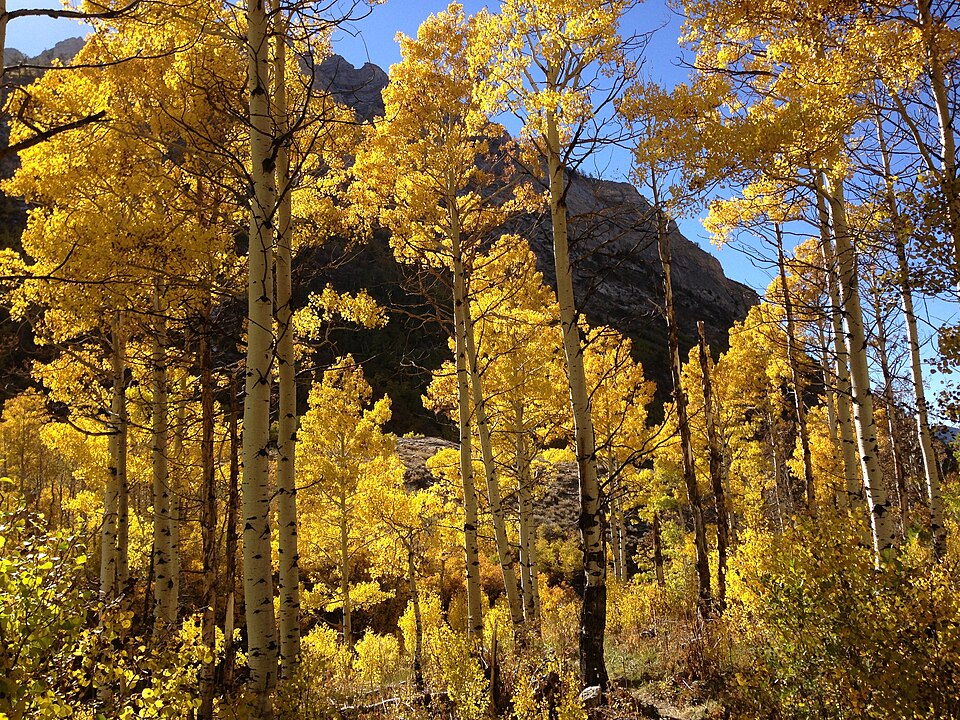
Quaking Aspen
Populus tremuloides
The most widely distributed tree in North America, famous for the way its flattened leaf stalks make foliage tremble in the slightest breeze and for brilliant gold fall color. It spreads by root suckers into vast genetically identical clonal stands. Short-lived and disease-prone at lower, warmer elevations.
Field reference
Family
Salicaceae
Growth rate
Fast
Mature size
40–50 ft tall, 20–30 ft spread
Hardiness zone
1–6
Soil preference
Moist, well-drained sandy or gravelly soils; cool climates
Sun
Full sun
Pruning window
Late winter (dormant)
Wood properties
Soft, light, weak, fine-grained wood (~0.38 SG) used mainly for pulp, pallets, and OSB. Short-lived, decay-prone stems; suckering clones complicate removals.
Native range
Across northern North America and the western mountains, the most widespread native tree
Green weight
43 lb/ft³
Pests & diseases to watch
Spongy Moth (formerly Gypsy Moth)pest · High severity · peak Caterpillars feed and defoliate May–June; egg masses laid mid-summer overwinterCytospora Cankerfungus · Moderate severity · peak Cankers expand in spring and fall; symptoms most visible in summer diebackArmillaria Root Rotfungus · High severity · peak Decline visible in summer drought stress; honey mushrooms appear in fall
Common questions
Why does my aspen send up shoots all over the lawn?
Aspen reproduces by root suckers, so a single tree can colonize a wide area with clonal shoots. Repeated mowing or removing the parent's stress triggers (like topping) helps limit suckering.
Why is my aspen short-lived in a warm climate?
Quaking aspen is adapted to cool northern and high-elevation sites. In hot lowland landscapes it suffers cankers, borers, and decline, rarely reaching the age it does in the mountains.
Related species in Salicaceae
Tree Nerd Academy
Ready to sit the ISA Certified Arborist exam?
Video curriculum, flashcards, and exam-sim built by working arborists.