
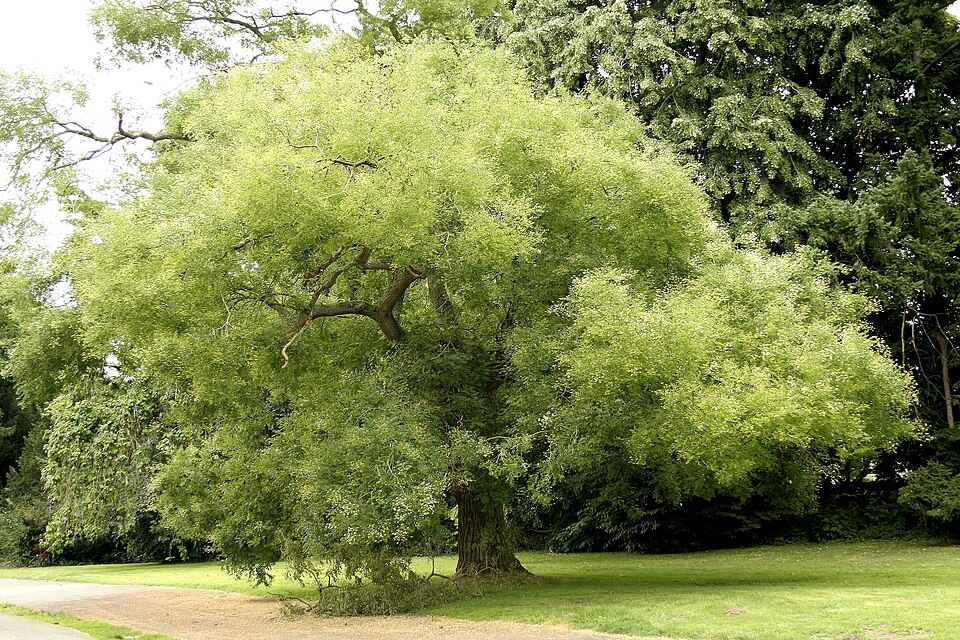
Japanese Pagoda Tree (Scholar Tree)
Styphnolobium japonicum
A tough urban shade tree, one of the few large trees flowering in summer with big creamy panicles, followed by knobby bean pods. Highly tolerant of heat, drought, pollution, and poor soils, it is a reliable city and street tree; young trees are gangly and need structural pruning to develop good form.
Field reference
Family
Fabaceae
Growth rate
Moderate
Mature size
50–75 ft tall, 50–75 ft spread
Hardiness zone
4–8
Soil preference
Adaptable — tolerates drought, heat, pollution, and compacted urban soils
Sun
Full sun
Pruning window
Dormant season; structure young trees, which start out gawky
Wood properties
Hard, durable legume wood; strong limbs once mature. Young trees are awkwardly branched and benefit from early structural pruning to build an even crown.
Native range
Native to China and Korea; widely planted as an urban street tree
Green weight
48 lb/ft³
Pests & diseases to watch
Common questions
Why is it valued as a city tree?
Japanese pagoda tree shrugs off heat, drought, air pollution, and compacted urban soils better than most large shade trees, and it adds rare summer flowers, making it a dependable street and plaza tree.
Why does my young pagoda tree look awkward and floppy?
Young trees are notoriously gangly with weak, crossing branches, but they develop into a handsome rounded canopy. Early structural pruning to a strong leader and well-spaced scaffolds is well worth it.
Related species in Fabaceae
Tree Nerd Academy
Ready to sit the ISA Certified Arborist exam?
Video curriculum, flashcards, and exam-sim built by working arborists.