
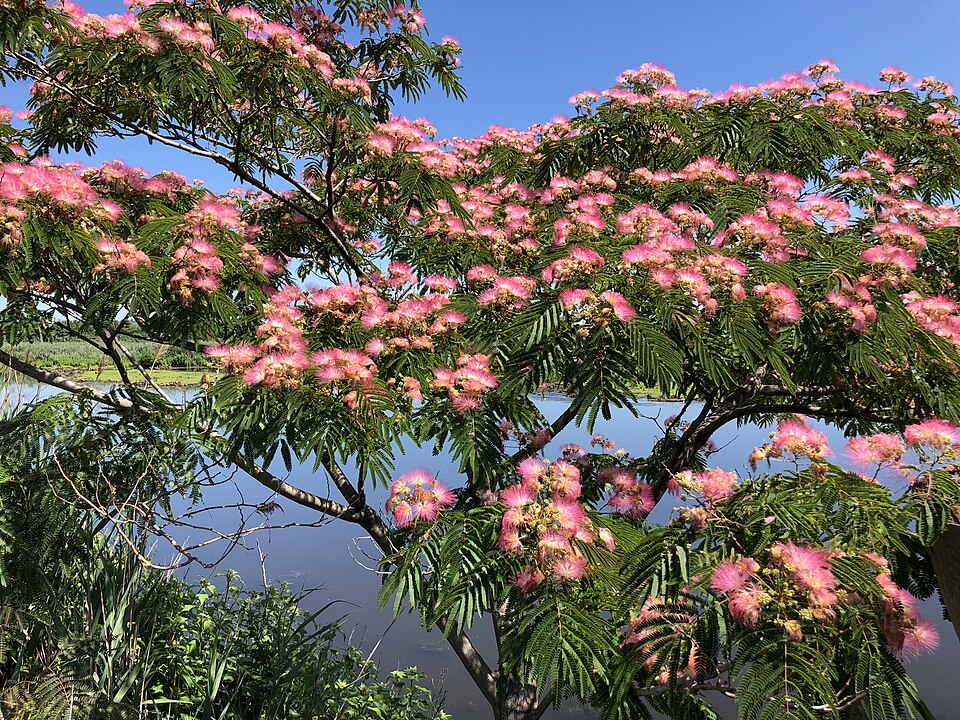
Mimosa (Silktree)
Albizia julibrissin
A fast, fragrant ornamental with feathery foliage and pink powderpuff summer flowers — but an aggressive invasive across the South and lower Midwest, seeding heavily into disturbed ground and roadsides. Short-lived, brittle, and weak-forked, and devastated by mimosa vascular wilt (a Fusarium fungus), so it is increasingly removed rather than planted.
Field reference
Family
Fabaceae
Growth rate
Fast
Mature size
20–40 ft tall, 25–50 ft spread
Hardiness zone
6–9
Soil preference
Grows almost anywhere — drought, poor soil, and roadside conditions included
Sun
Full sun
Pruning window
Dormant season; weak forks and frequent deadwood
Wood properties
Light, weak, brittle legume wood of little value. Brittle, wide-spreading limbs that break readily; short-lived and decay-prone, a frequent storm-damage and removal tree.
Native range
Native to Asia; highly invasive across the southeastern and south-central United States
Green weight
45 lb/ft³
Common questions
Is mimosa invasive?
Yes — Albizia julibrissin seeds prolifically, resprouts when cut, and colonizes roadsides, fields, and stream corridors across the South and Midwest, where it is listed as invasive. Removal usually requires treating the stump to stop resprouting.
Why do mimosa trees often die suddenly?
Mimosa (Fusarium) wilt, a soilborne fungal disease, girdles the vascular system and kills trees, often after years of decline. There is no cure; the disease, plus brittle storm-prone wood, makes mimosa a short-lived, high-maintenance tree.
Related species in Fabaceae
Tree Nerd Academy
Ready to sit the ISA Certified Arborist exam?
Video curriculum, flashcards, and exam-sim built by working arborists.