
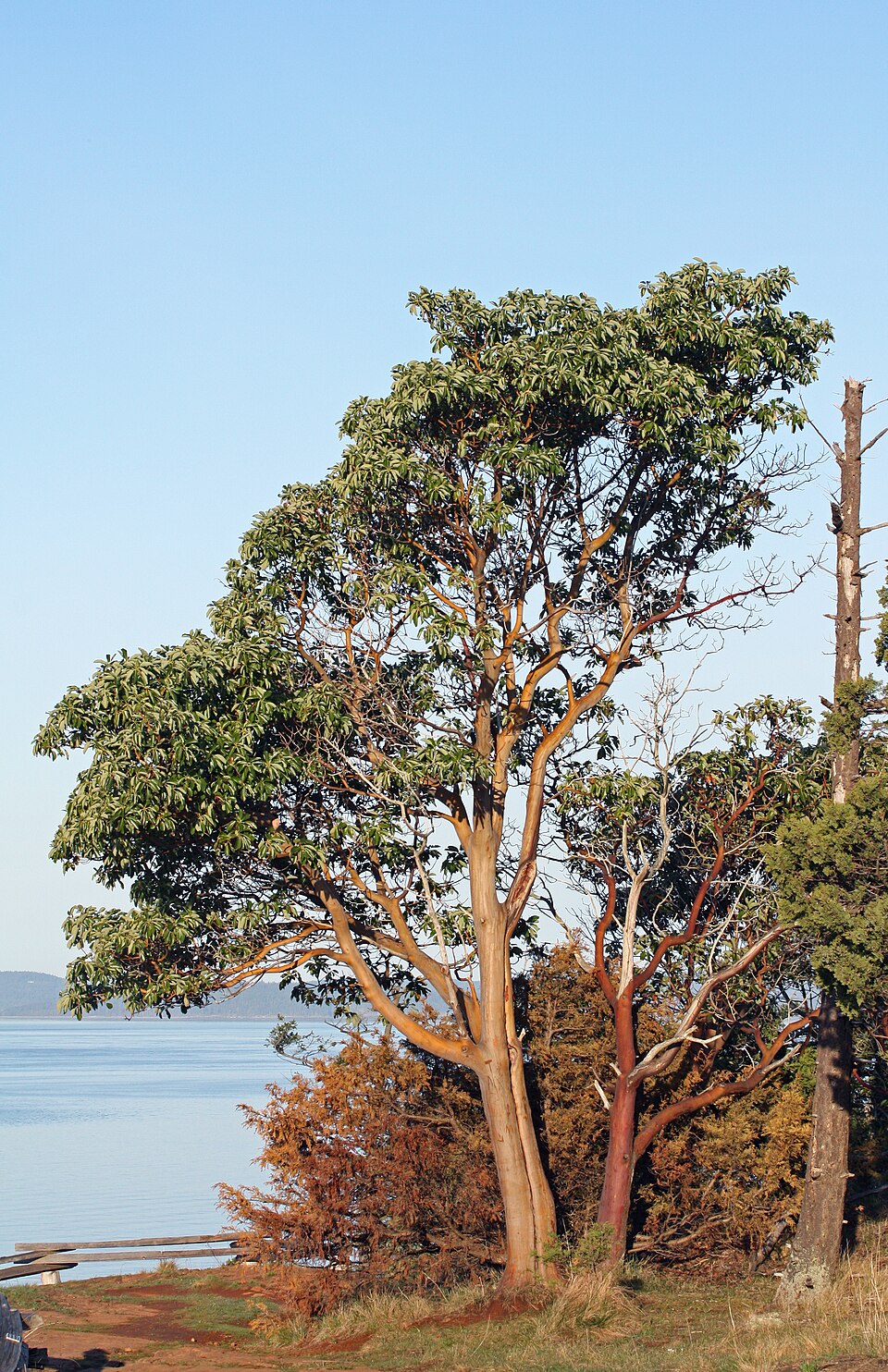
Pacific Madrone
Arbutus menziesii
A spectacular broadleaf evergreen of the Pacific coast, with peeling cinnamon-red bark over satiny new bark, white spring flowers, and red berries. Notoriously difficult in cultivation — it demands sharp drainage and dry summers, resents irrigation and root disturbance, and is plagued by fungal cankers and leaf blights, so it is best conserved where it already grows.
Field reference
Family
Ericaceae
Growth rate
Slow
Mature size
30–80 ft tall, 20–50 ft spread
Hardiness zone
7–9
Soil preference
Sharp-draining, dry, rocky soils; extremely intolerant of summer water and root disturbance
Sun
Full sun
Pruning window
Dry summer only; very prone to canker through wet-season wounds
Wood properties
Hard, heavy, dense wood that warps badly as it dries; used for veneer, flooring, and charcoal. Strong but brittle limbs; striking peeling red-orange bark over smooth green-tan wood.
Native range
Pacific coast of North America, British Columbia to Southern California
Green weight
58 lb/ft³
Common questions
Why is Pacific madrone so hard to grow or keep alive?
It is exquisitely adapted to dry, sharply drained native sites and resents summer irrigation, fertilizer, grade changes, and root disturbance — exactly the conditions of typical landscapes. Many declines trace to overwatering and construction impacts; protect existing trees rather than transplanting.
Is the peeling bark on madrone normal?
Yes — madrone naturally sheds its thin outer bark in curling cinnamon-red flakes, revealing smooth, satiny green-to-tan new bark beneath. It is one of the tree's most beautiful features, not a sign of disease.
Related species in Ericaceae
Tree Nerd Academy
Ready to sit the ISA Certified Arborist exam?
Video curriculum, flashcards, and exam-sim built by working arborists.