
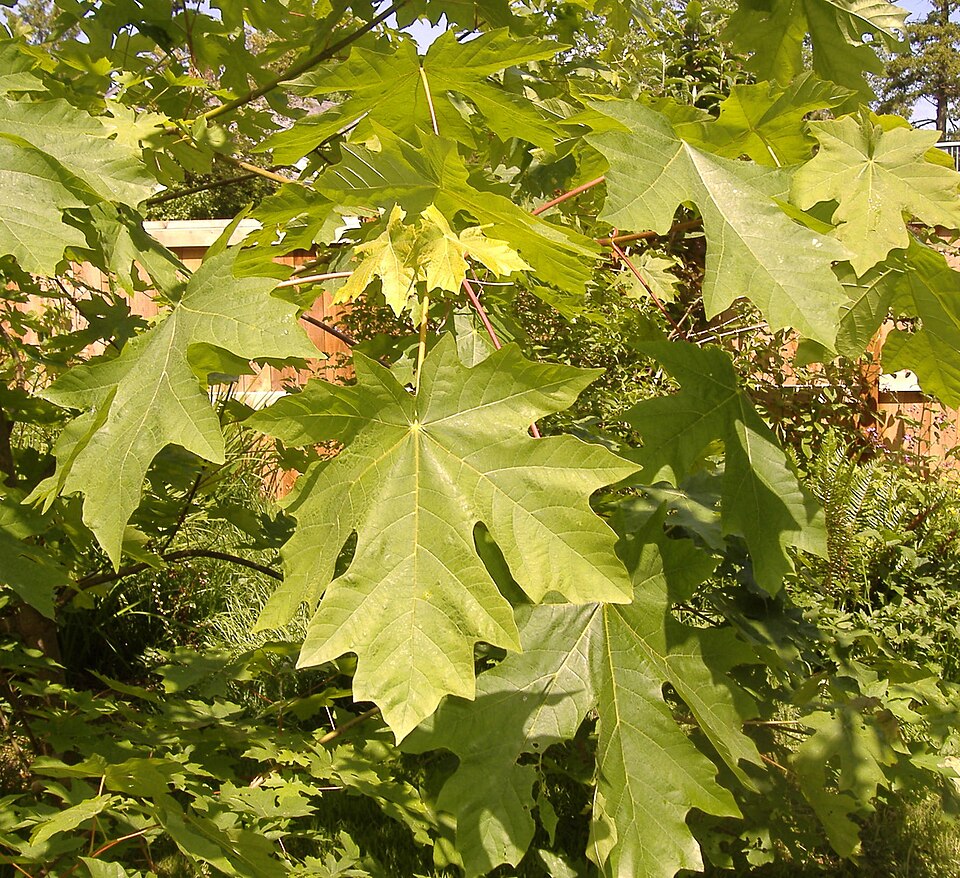
Bigleaf Maple
Acer macrophyllum
The Pacific Northwest's largest maple, with enormous leaves, fragrant spring flowers, and limbs draped in moss and ferns. Vigorous and quick, but prone to large codominant limbs and increasingly affected by a still-studied dieback in the region.
Field reference
Family
Sapindaceae
Growth rate
Fast
Mature size
50–80 ft tall, 30–50 ft spread
Hardiness zone
6–9
Soil preference
Deep, moist, well-drained soils of Pacific bottomlands and slopes
Sun
Full sun to part shade
Pruning window
Summer or late dormant season; avoid heavy spring sap flow
Wood properties
Moderately strong maple (~0.48 SG), often heavily moss- and epiphyte-laden in coastal forests. Big limbs hold real water weight when green — derate rigging for the extra load.
Native range
Pacific coast of North America, southern Alaska to Southern California
Green weight
47 lb/ft³
Pests & diseases to watch
Common questions
Why are the limbs covered in moss and ferns?
In the wet Pacific Northwest, bigleaf maple bark hosts thick mats of moss, lichen, and licorice ferns. The epiphytes are harmless to the tree but add significant weight to limbs you plan to rig.
What is causing widespread bigleaf maple dieback?
Researchers link the regional dieback to hotter, drier summers and site stress rather than a single pathogen. Maintaining soil moisture and avoiding root-zone damage gives stressed trees the best odds.
Related species in Sapindaceae
Tree Nerd Academy
Ready to sit the ISA Certified Arborist exam?
Video curriculum, flashcards, and exam-sim built by working arborists.