
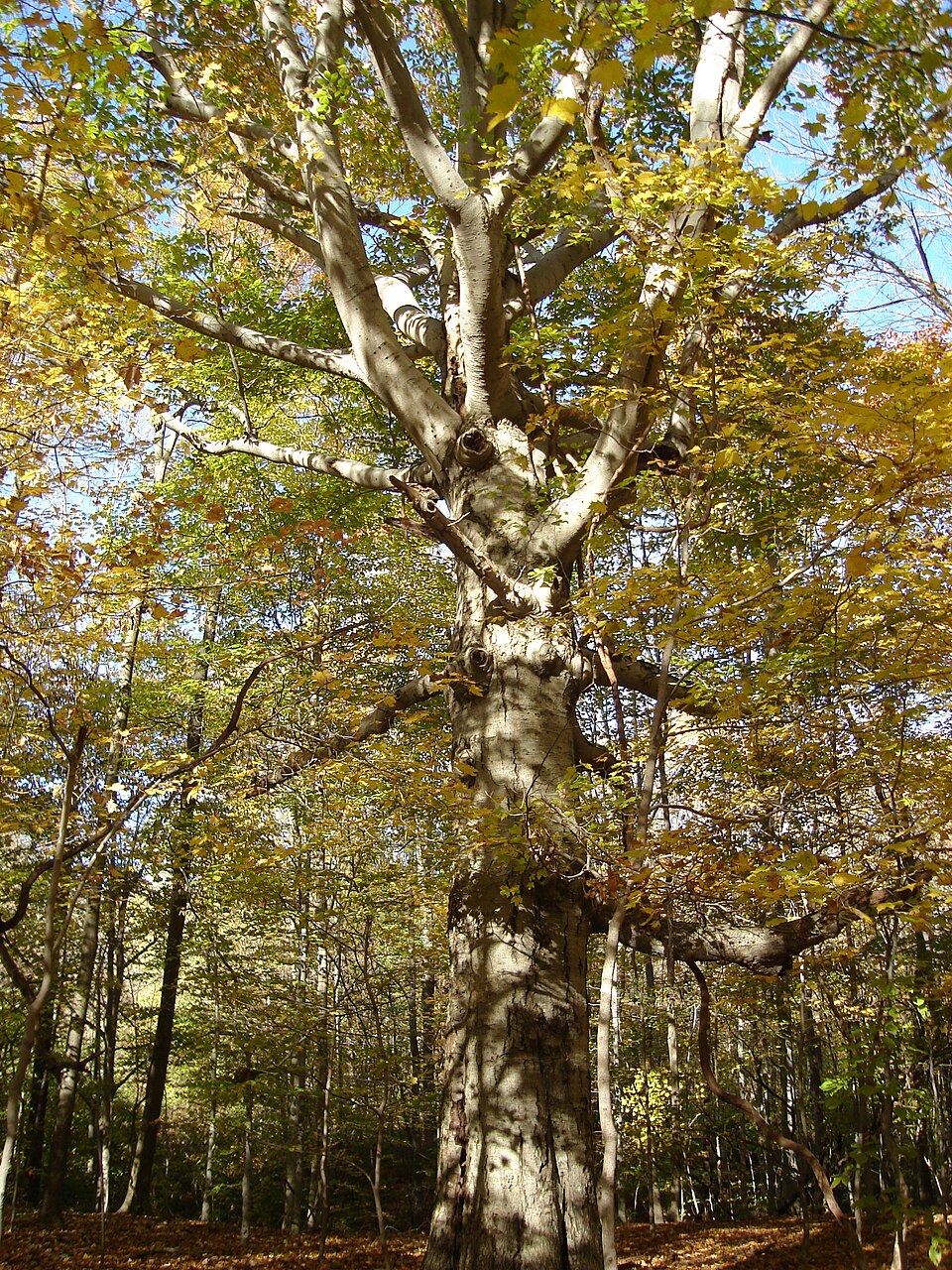
American Beech
Fagus grandifolia
A slow-growing, shade-tolerant climax forest tree with smooth gray bark and persistent tan winter leaves on juveniles. The thin bark is easily damaged and prone to sunscald when suddenly exposed. Now threatened by beech leaf disease and beech bark disease across its range.
Field reference
Family
Fagaceae
Growth rate
Slow
Mature size
50–70 ft tall, 40–60 ft spread
Hardiness zone
3–9
Soil preference
Moist, rich, well-drained acidic loam; intolerant of compaction
Sun
Full sun to shade
Pruning window
Mid-winter (dormant)
Wood properties
Hard, strong, heavy diffuse-porous wood (~0.64 SG) with smooth thin bark that scars and sunscalds easily. Strong limbs; protect the thin bark during climbing and rigging.
Native range
Eastern North America, Nova Scotia to Florida and west to Wisconsin and Texas
Green weight
54 lb/ft³
Pests & diseases to watch
Common questions
Why do my beech leaves stay on through winter?
Young beeches and lower branches hold onto dead tan leaves until spring, a trait called marcescence. It is normal and not a sign of stress.
Why does my beech have smooth bark with scars that won't heal?
Beech bark is unusually thin and does not compartmentalize surface wounds well, so carving, sunscald, and mechanical injury leave lasting marks. Avoid wounding and sudden exposure.
Related species in Fagaceae
Tree Nerd Academy
Ready to sit the ISA Certified Arborist exam?
Video curriculum, flashcards, and exam-sim built by working arborists.