
Rigging Forces Explained: Why Negative Blocking Doubles Your Load
The piece weighs 400 lb but your rigging point sees far more. Understand fall distance, shock load, and why lowering above the rigging point is the most dangerous cut you make.
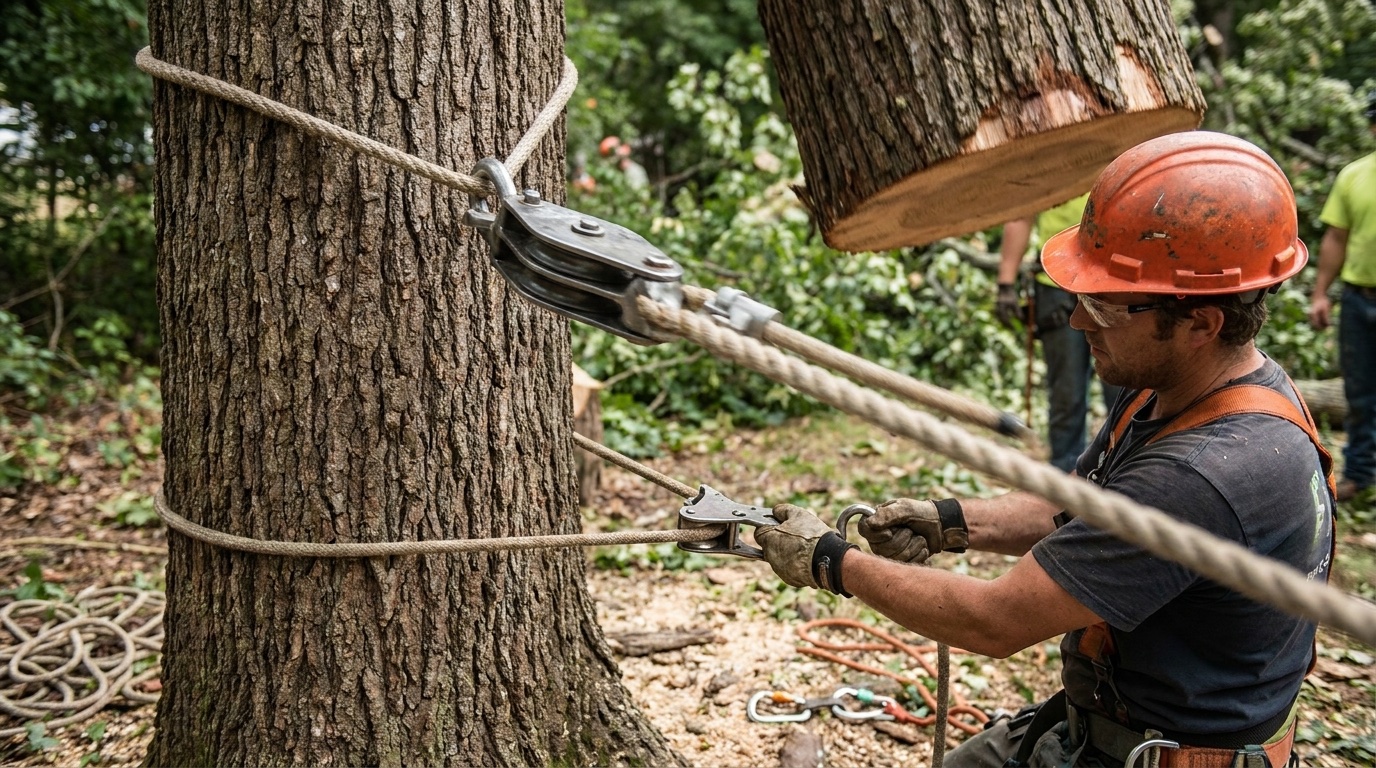
Every rigging failure starts with the same mistake: treating the weight of the piece as the load on the system. The number that actually matters is the peak dynamic load — the force that hits your rigging point at the instant the piece is arrested. That number is almost never the static weight, and with negative blocking it can be a multiple of it.
Static weight is just the entry fee
A green hardwood log can run 50–60+ lb per cubic foot. A 16-inch-diameter, 4-foot oak section is roughly 350–400 lb before you account for stubs and side limbs. That's your static load — what the system holds when nothing's moving.
The moment that piece falls and the line comes tight, you add dynamic load: the energy of the falling mass converted into force as the rope, friction device, and rigging point decelerate it. How much that multiplies the static weight depends on three things:
- Fall distance before the line loads — more drop, more velocity, more energy to absorb.
- The arresting distance — how much the system gives (rope stretch, friction let-out) while stopping the piece. A short, hard stop spikes the force; letting it run lowers the peak.
- The mass itself.
Why "above or below the rigging point" changes everything
This is the core idea every climber has to internalize.
Positive rigging (piece tied below the rigging point)
When the rigging point is above the cut, the piece can only fall the short distance until the line — already nearly taut — comes tight. Small fall distance, modest dynamic load. This is the controlled, lower-force scenario you want.
Negative rigging / negative blocking (piece tied below, rigging point below the cut)
When the rigging point is below the cut — you're blocking pieces down a spar and the false crotch or block is beneath where you're cutting — the piece free-falls the entire distance from the cut down past the rigging point before the line loads. That long free-fall builds real velocity, and the system has to kill all of it at once.
Field rule of thumb and the reason this article exists: negative blocking can roughly double the load on your rigging point compared to the equivalent positive scenario — and in bad setups (long spars, short slings, no give in the system) it goes well beyond double. The block, the sling, the rope, and the spar above the block all eat that spike.
Where the force goes — and where it bites
The peak load doesn't just live in the rope. It runs through:
- The rigging point / block — and the wood it's attached to. A negative-blocked spike can split a stem at the block or fail a marginal union.
- The friction device at the base, and the groundie running it. Too little let-out and they take the full spike through the bollard; too much and the piece hits the ground or a target.
- The sling and hardware — this is where published Working Load Limits and shock-load ratings stop being paperwork and start being the difference between a normal day and a fatality.
Lowering the peak in practice
- Reduce piece size. The single most effective lever. Smaller pieces, more cuts. Production pressure is the enemy here.
- Minimize fall distance. Tie the piece short and high; keep the rigging point as close above the cut as the job allows.
- Let it run. A controlled let-out on the friction device stretches the arresting distance and shaves the peak — balanced against drop zone and targets below.
- Build in give. Some rope stretch and dynamic slings absorb energy that a static, bottomed-out system would dump straight into your hardware.
- Respect the spar. On a removal, the wood above your block is structural. Sound it, and don't ask a decayed or split stem to arrest a negative-blocked piece.
The takeaway
Rig from above whenever the tree gives you the option. When the job forces you negative — and removals constantly do — assume the load is at least double, cut smaller, let it run, and size your hardware to the spike, not the static weight. The piece never killed anyone. The deceleration did.
Tools referenced in this article
FAQ
Does negative blocking really double the load?
What's the fastest way to lower rigging forces on a removal?
Video curriculum, flashcards, and exam-sim built by working arborists.